Rearranging Work

Every few decades, we convince ourselves that this time is different.

This time, technology won’t just change jobs.
It will eliminate them.

We said it about the automobile.
We said it about electricity.
We said it about the internet.

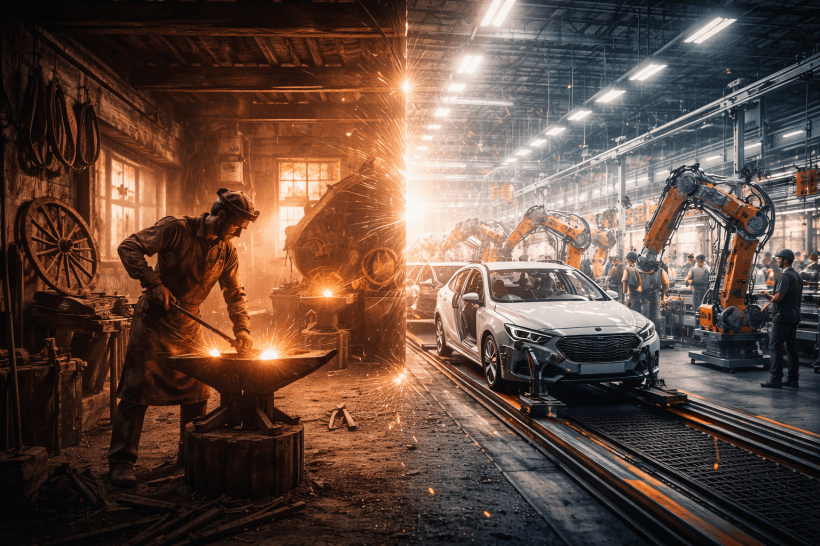
Henry Ford didn’t eliminate work.
He rearranged it.

Yes, there were fewer blacksmiths and buggy makers.
But there were more mechanics, factory workers, road builders, traffic engineers, gas station operators, parts manufacturers, and logistics planners.

Entire industries formed around the new tool.

AI feels similar.

It will eliminate certain patterns of work. That’s inevitable.
But it will also create entirely new layers of responsibility, maintenance, integration, oversight, and design.

The mistake is assuming the surface change is the whole story.

The deeper story is value migration.

Work doesn’t disappear.
It moves.

The interesting question isn’t “Will AI replace engineers?”

It’s “What new responsibilities will emerge because of AI?”

That’s where the opportunity is.

Responsibility Shows Up Eventually

We’ve reached an interesting moment with AI.

The conversation is shifting from “what can it do?” to “who is responsible when it does whatever it does?”

That shift was inevitable.

Every wave of technology eventually runs into the same wall.
Power scales faster than accountability.

Governance is starting to heat up as a topic around AI agents. Some people hear that word and think control, restriction, or slowdown.

I hear something different.

I hear maturity.

Governance isn’t about limiting capability.
It’s about deciding where judgment lives.

If AI agents are going to act, decide, generate, and integrate into real systems, then responsibility can’t be an afterthought.

We don’t get to skip that step.

And maybe that’s a good thing.

Impressive Isn’t the Same as Satisfying

I watched the Super Bowl last night.

It wasn’t big or bold. It was boring.
Clean. Technically solid. Well produced.

I even watched both halftime shows at the same time. They were fine.
The commercials too. A few were funny.

The whole thing just didn’t stick with me.

Maybe it was because the Chiefs weren’t there this year. That probably played a role. But it was more than that.

That feeling has been showing up a lot lately.

In sports.
In technology.
In AI announcements.

There’s no shortage of impressive things right now. New models. Bigger numbers. Clever demos. Even an AI-generated compiler that can play Doom.

It’s cool. I appreciate the engineering.

But impressive isn’t the same as satisfying.

Satisfaction comes from coherence. From purpose. From systems that do something meaningful over time, not just once on a stage.

Lately I’ve found myself drawn more to quiet work. Marching towards a CoffeeBreak beta launch. Restoring old systems. Building things slowly. Making sure I understand what I’m creating end to end.

Not because I don’t value progress.
But because I want the progress to matter.

That’s where the real work is.
That’s where it has always been.

Restoring Understanding

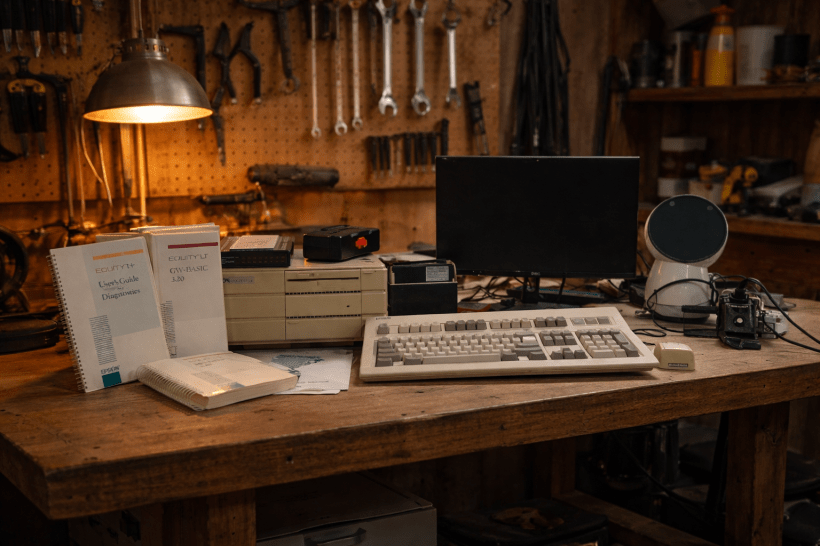
I’ve mentioned before that my first computer was an Epson Equity I+. I got it in 1987 and, unfortunately, got rid of it in the early 2000s. That decision has haunted me ever since.

Well, until recently, when I acquired one and started restoring it.

The restoration has brought back a flood of memories. I can feel the understanding growing every day, like a ten-year-old learning his first computer. Everything is new and fascinating. There’s a race to learn, to explore, to figure it all out.

As I dig into it, I’m constantly amazed. I can almost see the problems through the engineers’ eyes as they designed the hardware and software. There’s simplicity inside the complexity. When something doesn’t work, there aren’t ten layers of abstraction hiding the answer.

You can reason about it end to end.

That experience has been oddly grounding.

Modern systems are incredible, but they’re also opaque. We stack frameworks on platforms on services until even experienced builders rely more on trust than understanding. When something breaks, we hunt symptoms instead of causes.

Restoring this machine reminds me what it feels like to know a system again.
To see how choices connect.
To feel confident not because something is new, but because it’s clear.

That mindset has been showing up in how I think about CoffeeBreak.

AI tools are powerful. The progress is real.
But power without understanding doesn’t eliminate work. It just moves it around. Often onto people, quietly.

Unlike this restoration, with CoffeeBreak I’m not trying to build something nostalgic.
I’m trying to build something coherent.

There’s a quiet confidence that comes from knowing how a system works all the way through.

That’s the feeling I’m chasing, whether I’m restoring an old computer or building something new.