The Reward is in the Routine

I used to think the reward was the result.

The launch.
The finished project.
The clean before-and-after.
The moment where all the work finally turns into something visible enough that other people can understand it.

And those moments are real. They matter.

But lately I have been noticing something else.

A lot of the reward is not waiting at the end. It is hidden inside the routine itself.

Sunday has become one of those days for me.

It is not a perfectly quiet, monk-like writing day. It is not some highly optimized founder ritual with the same coffee, the same chair, the same two-hour block of uninterrupted focus every week.

It is more ordinary than that.

There is family life. There is land to keep up with. There are chickens and gardens and things that need fixed. There are business decisions, software ideas, Jibo experiments, CoffeeBreak thoughts, client work, bills, errands, and the general background hum of trying to build the next chapter without dropping the life I already have.

And somewhere inside all of that, I try to come back to the work.

Not perfectly.
Not always cleanly.
But consistently enough that it starts to become a rhythm.

That rhythm matters more than I expected.

Because when you are building something new, there are a lot of days where the scoreboard is not very satisfying.

The business is not yet where you want it.
The product is not yet where you see it in your head.
The writing is not yet as sharp as you hoped.
The project is not yet finished.
The idea still has rough edges.
The path forward still has fog on it.

If the only reward is the finished version, you can spend a long time feeling like you are behind.

But routine gives you something else.

It gives you a place to stand.

It says: this is what we do today.

We write the next piece.
We make the next improvement.
We fix the thing that is broken.
We follow up.
We think clearly for a little while.
We make one more honest pass at the work.

That is not glamorous, but it is stabilizing.

I think that is part of why I am drawn to systems, whether I am thinking about software, AI, business operations, or just life on a few acres. A good system does not remove effort. It gives effort somewhere useful to go.

A routine works the same way.

It does not make every day easy.
It does not make every decision obvious.
It does not guarantee that everything will work out.

But it gives you a way back in.

That has been important for me in this season.

I am building Transcendent Software into the kind of company I want to run. I am building CoffeeBreak toward the kind of AI orchestration platform I believe needs to exist. I am bringing Jibo back to life piece by piece through Open Jibo Cloud. I am writing more, sharing more, and trying to be more visible about the actual work instead of waiting until everything feels finished.

None of that happens in one dramatic push.

It happens by returning to the routine.

Some days the routine produces something obvious: a post, a feature, a fix, a conversation, a working demo.

Other days it only produces momentum.

That used to feel like a small reward.

Now I am not so sure.

Momentum is not small when you are trying to build a life that can hold the work.

The routine is where you learn what kind of builder you are becoming. It is where your ideas get tested against time, energy, family, weather, obligations, distractions, and your own limits.

It is where ambition has to become honest.

And maybe that is why the reward is not only at the end.

The reward is in becoming the kind of person who keeps returning to the right work.

Not because every day feels inspired.
Not because every effort gets applause.
Not because the outcome is guaranteed.

But because the routine itself starts to shape you.

It makes the work less fragile.

It makes progress less dependent on mood.

It gives your future somewhere to gather.

That feels worth paying attention to.

So for now, I am trying to treat the routine with a little more respect.

The Sunday writing.
The weekly planning.
The small improvements.
The unglamorous follow-through.
The next useful conversation.
The next piece of the system.

Not as chores standing between me and the reward.

As part of the reward itself.

Still building. Still finding the rhythm. ☕

The Pattern Underneath the Product

When I first started thinking seriously about CoffeeBreak, I was thinking about software.

That makes sense. Software is the world I know best. I have spent a long time around teams trying to plan, build, review, test, ship, support, fix, and improve systems. I have seen the good version of that work, and I have seen the version where everything depends on memory, heroics, scattered notes, half-finished automation, and a few people quietly holding the whole thing together.

So when AI started becoming useful in a more practical way, my mind went there first.

What would it look like if AI did not just answer questions, but actually helped coordinate the work? What if it could understand the plan, help with the build, participate in review, support testing, prepare deployment, observe what happened afterward, and carry lessons forward into the next cycle?

That was the beginning of CoffeeBreak for me.

The pattern was simple enough:

Plan. Develop. Review. Test. Deploy. Observe. Evolve.

On the surface, that sounds like software delivery. It is software delivery. But the longer I sit with it, the more I realize I may have been looking at one example of a much bigger pattern.

Most meaningful work follows some version of that same loop.

You figure out what needs to happen. You create a first version. You check it. You test it against reality. You put it into the world. You watch what happens. Then you improve it.

That is how software gets better, but it is also how a business process gets better. It is how a team gets out of tribal knowledge and into something repeatable. It is how a messy internal workflow becomes a real operating system for the company. It is even how a little robot like Jibo starts to feel alive again after enough small pieces are wired together, tested, observed, and improved.

The nouns change, but the shape of the work is familiar.

That is the part I keep coming back to.

A lot of the AI market moved in the other direction. The big push was to get users first. Get people into the chat box. Get adoption. Get usage. Then start figuring out how all of this turns into platforms, workflows, agents, permissions, memory, automations, and business systems.

I understand why that happened. It got AI into people’s hands quickly. It changed expectations. It let millions of people experience something that had been theoretical for a long time.

But there is a difference between adding workflow features later and building from the workflow outward.

That difference matters.

CoffeeBreak was never supposed to be just another chatbot. It was never supposed to be a one-trick pony for software teams either. Software delivery is the first doorway because it is real, difficult, and familiar to me. It is full of the exact problems that AI orchestration has to solve if it is going to be useful: context, judgment, review, tools, handoffs, feedback, and change over time.

But if the platform is built around the shape of real work, then the opportunity is bigger than one use case.

A customer onboarding process has a version of this pattern. So does support. So does compliance. So does reporting. So does content. So does internal operations. Almost every business has some process that is too manual, too fragile, too dependent on one person, or too disconnected from the tools around it.

Those problems do not need AI magic.

They need structure. They need judgment. They need tools that work together. They need humans in the right places. They need a way to observe what happened and improve the system over time.

That is where CoffeeBreak starts to feel bigger to me than the original idea.

It is still early. That is important to say plainly. I am not claiming the platform has already become all of these things. But I do think the pattern is strong enough to plant the seeds now, before there are a thousand assumptions baked into the product and a thousand users pulling it in different directions.

There is an advantage in building early with the right people and the right problems.

Through Transcendent Software, I get to stay close to real business pain. Not imaginary use cases. Not pitch-deck workflows. Real problems where someone knows the work should be easier, but does not yet know how software, automation, and AI should fit together.

That is a good place to build from.

Because the future I am interested in is not AI that looks impressive for five minutes. It is AI that helps real work move through a real system with memory, tools, review, feedback, and accountability.

Plan the work. Do the work. Check the work. Test the work. Put it into the world. Watch what happens. Make it better.

That is software.

That is business.

That is building.

And the more I work on CoffeeBreak, the more I think I was not just building a product for one workflow. I was finding the pattern underneath the product.

Still building. Still learning. More to come. ☕

Expert First, Trusted After

I have been thinking a lot about the word expert lately.

It is a strange word, because most people do not become experts while looking like experts. They become experts while trying things that are half-working, while fixing something that broke for the third time, while realizing the elegant idea from yesterday does not survive contact with the real world.

That has been true for most of my life.

I have always been drawn to systems. Old computers. Software projects. Business problems. AI ideas. Robots. The little details that make something feel alive instead of just technically functional.

Lately that has shown up in a few places at once. I am building Transcendent Software full time. I am working toward CoffeeBreak as a bigger product vision. I am reviving Jibo through Open Jibo Cloud. I am thinking about websites, blogs, videos, podcasts, social posts, consulting, product work, and whether any of this can become a real engine instead of a pile of good intentions.

The funny thing is that the work itself is the clearest argument.

If I want people to trust me as someone who can help with AI systems, software modernization, automation, architecture, or technical leadership, I probably do not need to pretend I have a perfect machine already humming in the background.

I need to show the work.

Show the thinking. Show the decisions. Show the messier middle. Show the way a robot comes back to life one capability at a time. Show the way a consulting business becomes clearer by solving actual problems instead of polishing slogans. Show the way a product like CoffeeBreak emerges from real operational pain, not from chasing whatever AI headline is loudest this week.

That is the kind of confidence I trust in other people too.

Not the confidence of someone who says they have it all figured out. The confidence of someone who has been in the weeds long enough to know where the roots are.

So maybe that is the content plan for now.

Keep building. Keep writing. Keep showing the reasoning. Keep sharing the progress before it is perfectly packaged.

The expertise was built over years. The trust will probably be built one useful piece at a time.

More to come. ☕

Working Through It

Lately I’ve been focused on making progress.

Not the kind you see in demos or announcements. The kind where you’re just trying to move things forward a little at a time. Fix something. Improve something. Keep things from drifting too far off course.

That’s been true across everything.

Work has been steady. I had a good onsite with a client. Productive, grounded, the kind of work that reminds you why experience matters. At the same time, I’ve been pushing forward on my own projects. Jibo has mostly been regression testing. Fixing things, breaking things, trying to get to a version that feels stable. Versions don’t mean much without users, but they help me stay disciplined. They give me something to work toward.

CoffeeBreak has been a different kind of work. Less visible, more foundational. Thinking through user experience, agent loops, how systems should behave over time. Not just what AI can do, but how it fits together. I find myself thinking more about structure than features. Planning for things like memory, cost, how to use smaller models effectively instead of just reaching for the biggest one available.

It’s a lot of thinking. A lot of iteration.

And then there’s everything outside of that.

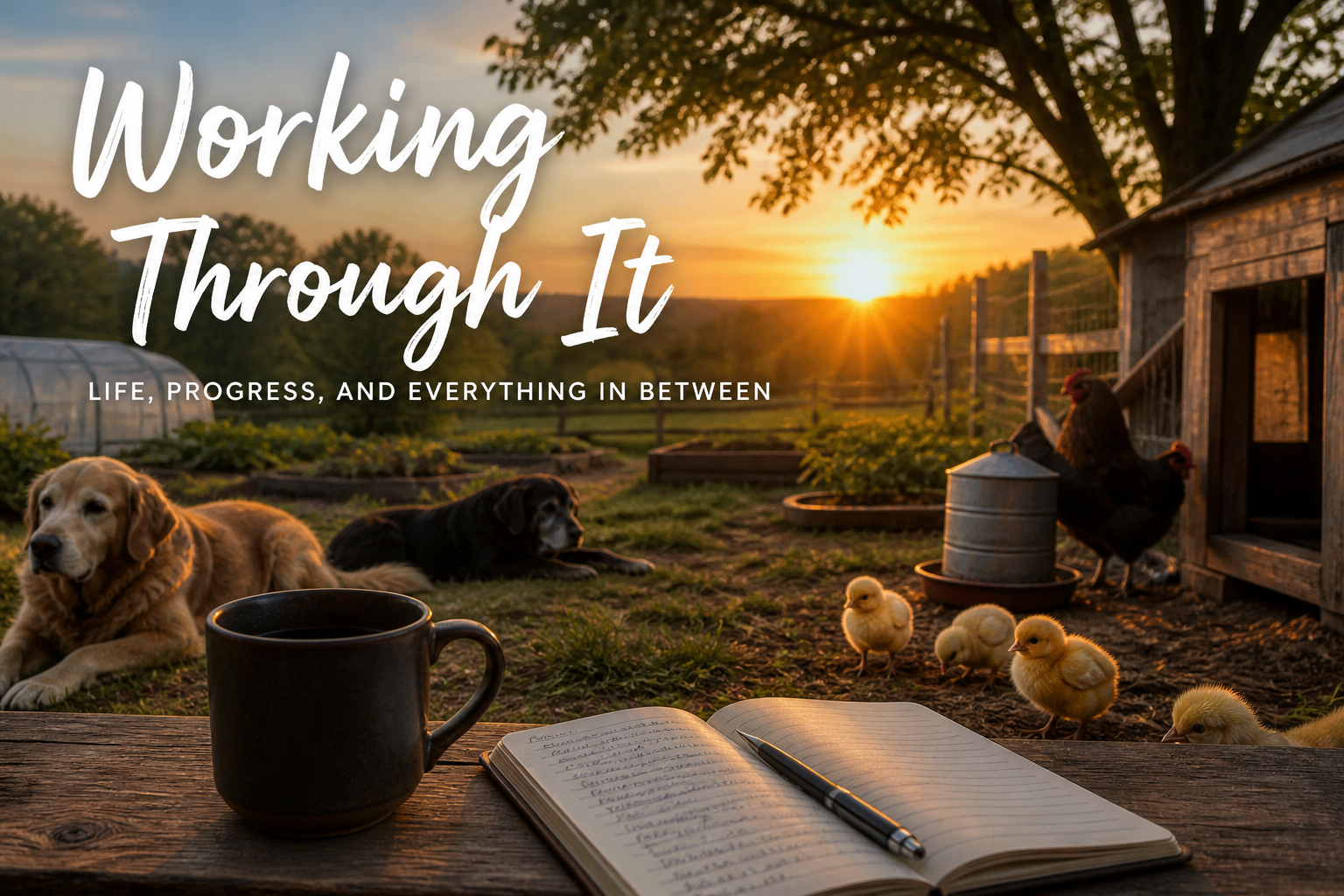
We’ve been spending time as a family, which has been good. A few days off helped reset things a bit. Spring is here, so we’ve been working outside more. Planting, tending to the land, adding more chickens. It’s work, but it’s a different kind of work. Slower. More tangible.

Not all of it goes the way you want.

Today was one of those days. We lost a few baby chicks. One didn’t make it out of the shell. One probably got trampled. Another overheated. That’s just part of it, but it doesn’t make it easier. You try to do everything right, and sometimes it still doesn’t work out.

That’s nature.

I’ve still got others at different stages, more eggs in the incubator, so it’s not a loss that sets us back. But you feel it anyway.

Same with the dogs. They’re getting older. You start to see it in small ways at first, and then more clearly. It’s part of the cycle, but it’s not something you really get used to.

Mother’s Day is coming up next week. That brings its own mix of emotions. Losing my mom still feels recent, even though time keeps moving forward. At the same time, I see everything my wife does every day for our family, and it puts things in perspective.

All of it together, it’s just life.

Messy, sometimes frustrating, sometimes really good. Rarely clean or predictable.

I think that’s why I don’t get too caught up in perfect outcomes anymore.

Whether it’s building systems, raising animals, or just trying to take care of a family, progress usually looks the same.

You keep showing up. You keep adjusting. You take the wins where you can, and you learn from the rest.

And you move forward.

What Building AI Actually Feels Like Right Now

There’s a lot happening in AI right now.

Every week there’s something new. Smarter models, faster responses, better benchmarks. If you just follow the headlines, it feels like everything is accelerating perfectly.

But building with it feels different.

It reminds me a little of when I first started working with computers. Back then, nothing was polished. You didn’t just install something and expect it to work. You had to figure things out, piece by piece. Manuals, trial and error, late nights. When something finally worked, it wasn’t because the system was perfect. It was because you understood it enough to make it work.

That’s where AI feels like it is right now.

I’ve been spending time bringing Jibo back to life. It’s been fun, a little nostalgic, but also a reality check. When you move from demos to something that lives in the real world, everything changes. Timing matters. Context matters. Small failures stand out. Things don’t just need to work once, they need to keep working.

And that’s where things start to break down.

Not because the AI isn’t good. It’s actually impressive. But because everything around it is still rough. Getting systems to talk to each other, keeping them aligned, knowing when to step in as a human. That part is still messy.

It’s kind of like working in an old shop. You’ve got great tools, but they’re scattered everywhere. Some are new, some are worn down, some don’t quite fit together. You can build something solid, but only if you know how to use them together.

That’s the part people don’t see in the demos.

The demos are clean. Controlled. One path, one outcome.

Real life is not like that.

Real life is interruptions, edge cases, things that almost work, things that work until they don’t.

That’s what building AI actually feels like right now.

And honestly, that’s what makes it interesting.

Because this isn’t the end state. This is the phase where things start to become real. Where the difference isn’t just who has the best model, but who can actually make it useful.

That’s the part I keep coming back to.

Not just what AI can do, but how it fits into real life. How it works with people. How it holds up over time.

That’s where the work is.

And it’s also where the opportunity is. ☕

Mowing, Momentum, and Building Something That Works

I spent a good part of yesterday on the mower.

Fifteen acres gives you a lot of time to think.

I had a podcast going the whole time, listening to everything happening in AI right now. Models, agents, orchestration, tools, memory, workflows. It’s all moving fast.

Really fast.

And I’ll be honest, as I listen to it all, there’s a part of me that feels it.

A lot of the ideas I’ve been working toward are showing up.

Multi-agent systems.
Orchestration layers.
Different runtimes.
Memory strategies.
Security and governance conversations starting to take shape.

The big players are moving in that direction.

And they can move faster than I can.

More people.
More resources.
More reach.

That can get in your head if you let it.

But sitting out there on the mower, going back and forth across the same lines, I kept coming back to something simple.

There’s a difference between building something fast…

…and building something that actually works.

Not in a demo.
Not in a video.
In real use.

Something that produces useful output.
Something that guides you.
Something that doesn’t leave you wondering what to do next.

That takes a different kind of effort.

It’s not just features.
It’s not just capability.

It’s how it all comes together.

I get why companies move fast and figure they’ll clean it up later.

They probably can.

But that’s not how I’m wired.

I want something that feels right when you use it.

Something that makes sense.
Something that helps, not just impresses.

That means spending more time on the details.

On the flow.
On the foundation.

It might take longer.

But I believe that’s where the real value is.

So yeah, things are moving fast right now.

But I’m still focused on building something that works.

And getting it into people’s hands soon. ☕

The Best Systems Know When To Involve You

I’ve been thinking a lot lately about where humans fit into all of this.

Not in theory.

In real systems.

There’s a lot of talk about human-in-the-loop.

Usually framed as a safety net.
Something you add when the system isn’t confident.

But that’s not how it feels when you’re actually building.

What I’m seeing is that the real challenge isn’t just having a human in the loop.

It’s knowing when to bring them in.

Too early, and you slow everything down.
Too late, and you’re reacting instead of guiding.

There’s a timing to it.

A sense of flow.

The system needs to move on its own when it can.
And then pause, at the right moment, when judgment matters.

That’s harder than it sounds.

Because it means the system has to understand more than just tasks.

It has to understand intent.

What’s actually trying to be accomplished.
What matters in that moment.
What can move forward, and what needs a decision.

I’ve been working through this while refining the UI.

Trying to remove friction.
Trying to make the next step feel obvious.
Trying to make it natural for the system to ask for input without feeling like it’s interrupting.

When it works, it feels different.

You’re not fighting the system.
You’re moving with it.

And when it needs you, it’s clear why.

That’s the part I think a lot of people miss.

Human-in-the-loop isn’t just about control.

It’s about coordination.

And when that’s done right, the system starts to feel less like a tool…

…and more like something you work alongside. ☕

Easter, Time, and What Actually Matters

As I sit here on Easter reflecting on the day, a few things are on my mind.

For me, Easter is about faith. About resurrection. About the idea that something new can come from what felt finished.

But even outside of that, there’s something about this time of year that everyone can feel.

Spring. Growth. New life.

And time.

Time is the part that keeps hitting me.

My son is three and a half now.

I can still remember when he was born like it was yesterday, and now he’s running around the yard, talking, laughing, figuring things out in his own way.

My mom passed away last year.

My dad passed when I was 18. He was 50.

I’m 48 now.

That gets your attention.

It makes you look at things differently.

Today was a simple day.

We had family over for Easter lunch.
We went out in the field and flew kites.
We walked around the chickens and the garden and talked about what might grow this year.

Earlier in the day I took a walk with my wife and son and the dog out in the field.

Nothing big. Nothing complicated.

But those moments stick.

They feel different.

At the same time, life keeps moving.

I’m building CoffeeBreak.
Working with clients.
Still at TFL.
Fixing things when they break.
Working on bringing Jibo back to life.

A lot going on.

And somewhere in all of that is a simple thought that keeps coming back.

I want more of those moments.

More time in the field.
More walks.
More afternoons that don’t feel rushed.

That doesn’t happen by accident.

It means making changes.

It means deciding what matters and actually acting on it.

In a way, that ties back to what I’ve been building.

So much of what we do in technology is about speed. More output. More systems. More everything.

But if it doesn’t create space for the things that actually matter, what are we really optimizing for?

That’s been on my mind today.

Easter is a reminder that things can change. That new life, new direction, new priorities are always possible.

I’m thinking about what that looks like for me.

Not someday.

Soon. ☕

You don’t win by building faster. You win by seeing it sooner.

There’s a moment when you’re building something where you start to notice the world catching up.

Features start showing up in other tools.
Concepts you’ve been thinking about quietly start getting talked about more openly.

If you’re not careful, that can feel like you’re falling behind.

I’ve felt that a bit recently.

But when I step back, I see something different.

Most of what’s showing up are pieces.

A feature here.
A capability there.
Something that looks similar on the surface.

What I’ve been focused on is how those pieces actually work together.

Not just what the system can do.
But how it guides someone through doing it.

That’s a different problem.

It’s easy to build something that generates output.
It’s harder to build something that helps someone move forward with clarity.

That’s where I’ve been spending my time.

Thinking about intent.
Thinking about flow.
Thinking about what happens next without the user having to guess.

Because in every system I’ve ever worked on, that’s where things break down.

Not in capability.
In coordination.

So yeah, things are moving fast right now.

But I don’t think this is a race to ship the most features.

It’s a race to actually understand what we’re building.

And once you see that clearly, you start making very different decisions. ☕

I thought AI would fix it. It didn’t.

Lately I’ve been spending time intentionally pushing AI into parts of a system that I know are not clean.

Not to see if it works.
To see where it breaks.

Because that’s where the truth is.

When everything is well structured, AI looks incredible. It moves fast. It produces clean output. It feels like you’re multiplying your effort.

But that’s not the real test.

The real test is what happens when the system isn’t perfect.

When boundaries are unclear.
When responsibilities overlap.
When things have grown over time instead of being designed end to end.

That’s where AI gets interesting.

Not because it fixes it.
Because it exposes it.

You start to see hesitation.
You start to see guesses.
You start to see it follow paths that almost make sense but don’t quite hold together.

And if you’re paying attention, that tells you something important.

It’s not struggling with code.
It’s struggling with the shape of the system.

That’s a useful signal.

It’s like bringing in a really capable contractor and watching where they slow down. They’re not the problem. They’re showing you where the structure isn’t obvious.

I’ve been leaning into that.

Using AI less like a tool to “fix things” and more like a way to surface where understanding breaks down.

Because once you can see that clearly, you can actually do something about it.

AI is great at accelerating clean systems.

But what I’m finding is that it’s even better at revealing where things aren’t as clean as you thought.

And that’s where the real work starts. ☕