The Longest Day and the Smallest Question

Father’s Day and the summer solstice do not land together very often.

However you count the next one, we have a lot of years to wait before this alignment comes around again. That makes today feel worth noticing.

A day for fathers.
A day for light.
A day that marks the start of a new season.

When seasons change, it is a good time to pause. Not for too long, because the work rarely stops coming, but long enough to look around and ask what season you are actually in.

As a father, builder, and business owner, I keep learning that the work never really disappears. It just changes shape.

Sometimes you are planting seeds for a future harvest. Sometimes you are repairing things that did not go as well as you hoped. Sometimes you are trying to appreciate what is already growing right in front of you. And if you are lucky, you get another chance to reap what you sowed, learn from it, and prepare better for the next season.

My son is almost four now, and he is fully in his “why?” phase.

No matter where we are, what we are doing, or what we are talking about, he wants to know why.

Why does that happen?
Why do we do it that way?
Why can’t I have that?
Why is it time to leave?
Why?

It is fun. It is also humbling. Explaining life in the simplest possible terms is harder than it sounds. I never thought I would be the dad who said “because I said so,” but I may have said it more times than I care to admit.

That little question has been following me into my work too.

A lot of my life right now is building, planning, reaching out, managing money, writing, marketing, experimenting, and trying to grow Transcendent Software into the next season. It is exciting. It is also a patience exercise.

For most of my career, I was used to feedback coming from somewhere. Sometimes it was good feedback. Sometimes it was frustrating feedback. Sometimes I had to wait longer than I wanted for the right feedback. But feedback is feedback. It helps steer the ship.

Now the feedback loops are different.

Some days are outreach. Some days are writing. Some days are building CoffeeBreak. Some days are working on Open Jibo. Some days are finances, planning, or figuring out what message will connect with the right person at the right time.

The work is still there. The season is just different.

And maybe that is the lesson of Father’s Day landing on the solstice.

The longest day is not empty just because there is more light. It gives you more room to notice what needs attention.

Where are the seeds going in?
What needs repair?
What have I already been given?
What is this season asking of me?

My son keeps asking why because he is trying to understand the world.

I think adults need that question too. Maybe especially when we are busy. Maybe especially when we are building something new.

Why am I doing this?
Why does this matter?
Why this way?
Why now?

Some seasons are for planting. Some are for harvest. Some are for repair. Some are for patience.

The trick is learning which one you are in.

Happy Father’s Day to all the dads out there. I hope you get a little extra light today, and maybe a minute to notice what this season is asking of you. ☕

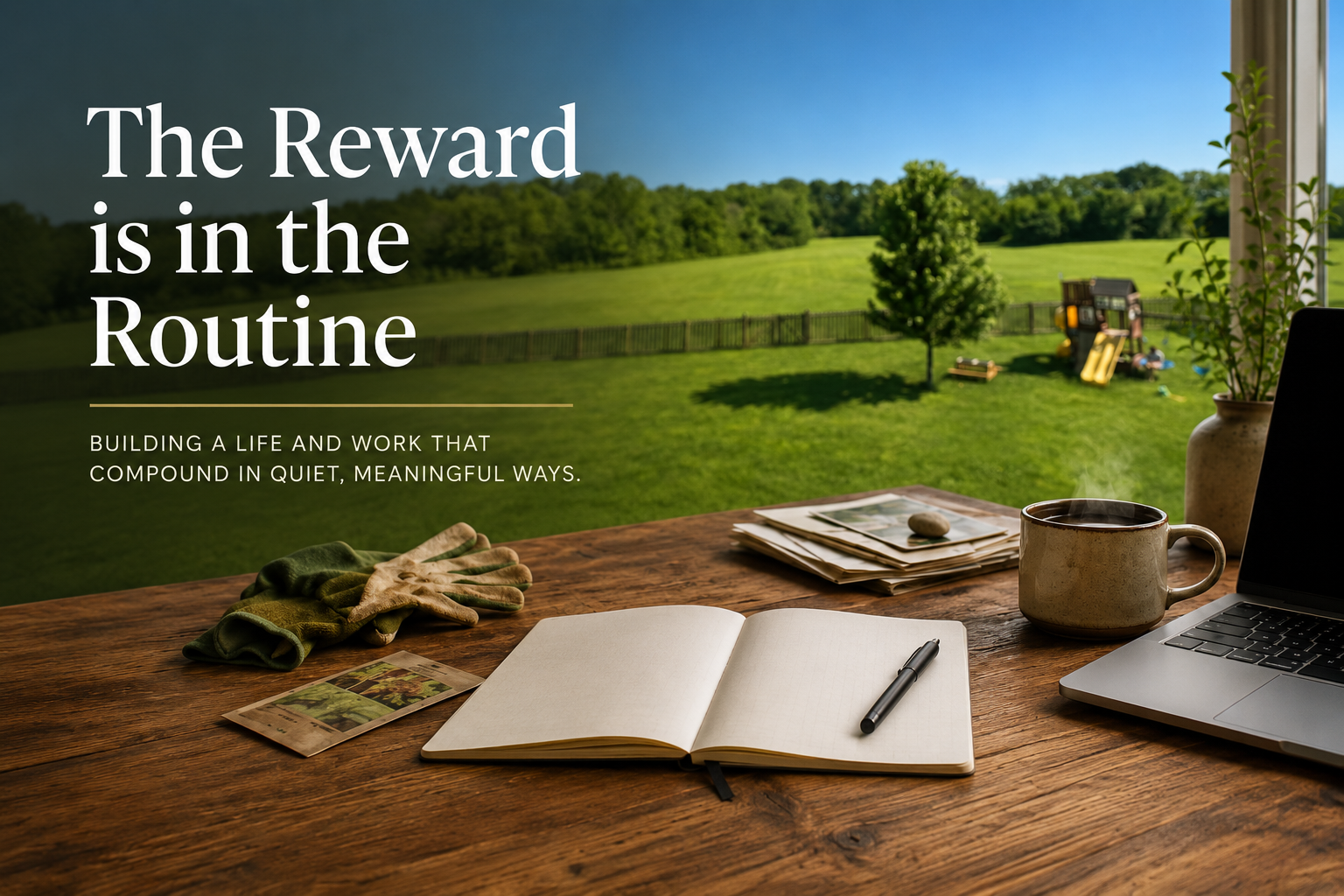
The Reward is in the Routine

I used to think the reward was the result.

The launch.
The finished project.
The clean before-and-after.
The moment where all the work finally turns into something visible enough that other people can understand it.

And those moments are real. They matter.

But lately I have been noticing something else.

A lot of the reward is not waiting at the end. It is hidden inside the routine itself.

Sunday has become one of those days for me.

It is not a perfectly quiet, monk-like writing day. It is not some highly optimized founder ritual with the same coffee, the same chair, the same two-hour block of uninterrupted focus every week.

It is more ordinary than that.

There is family life. There is land to keep up with. There are chickens and gardens and things that need fixed. There are business decisions, software ideas, Jibo experiments, CoffeeBreak thoughts, client work, bills, errands, and the general background hum of trying to build the next chapter without dropping the life I already have.

And somewhere inside all of that, I try to come back to the work.

Not perfectly.
Not always cleanly.
But consistently enough that it starts to become a rhythm.

That rhythm matters more than I expected.

Because when you are building something new, there are a lot of days where the scoreboard is not very satisfying.

The business is not yet where you want it.
The product is not yet where you see it in your head.
The writing is not yet as sharp as you hoped.
The project is not yet finished.
The idea still has rough edges.
The path forward still has fog on it.

If the only reward is the finished version, you can spend a long time feeling like you are behind.

But routine gives you something else.

It gives you a place to stand.

It says: this is what we do today.

We write the next piece.
We make the next improvement.
We fix the thing that is broken.
We follow up.
We think clearly for a little while.
We make one more honest pass at the work.

That is not glamorous, but it is stabilizing.

I think that is part of why I am drawn to systems, whether I am thinking about software, AI, business operations, or just life on a few acres. A good system does not remove effort. It gives effort somewhere useful to go.

A routine works the same way.

It does not make every day easy.
It does not make every decision obvious.
It does not guarantee that everything will work out.

But it gives you a way back in.

That has been important for me in this season.

I am building Transcendent Software into the kind of company I want to run. I am building CoffeeBreak toward the kind of AI orchestration platform I believe needs to exist. I am bringing Jibo back to life piece by piece through Open Jibo Cloud. I am writing more, sharing more, and trying to be more visible about the actual work instead of waiting until everything feels finished.

None of that happens in one dramatic push.

It happens by returning to the routine.

Some days the routine produces something obvious: a post, a feature, a fix, a conversation, a working demo.

Other days it only produces momentum.

That used to feel like a small reward.

Now I am not so sure.

Momentum is not small when you are trying to build a life that can hold the work.

The routine is where you learn what kind of builder you are becoming. It is where your ideas get tested against time, energy, family, weather, obligations, distractions, and your own limits.

It is where ambition has to become honest.

And maybe that is why the reward is not only at the end.

The reward is in becoming the kind of person who keeps returning to the right work.

Not because every day feels inspired.
Not because every effort gets applause.
Not because the outcome is guaranteed.

But because the routine itself starts to shape you.

It makes the work less fragile.

It makes progress less dependent on mood.

It gives your future somewhere to gather.

That feels worth paying attention to.

So for now, I am trying to treat the routine with a little more respect.

The Sunday writing.
The weekly planning.
The small improvements.
The unglamorous follow-through.
The next useful conversation.
The next piece of the system.

Not as chores standing between me and the reward.

As part of the reward itself.

Still building. Still finding the rhythm. ☕

The Pattern Underneath the Product

When I first started thinking seriously about CoffeeBreak, I was thinking about software.

That makes sense. Software is the world I know best. I have spent a long time around teams trying to plan, build, review, test, ship, support, fix, and improve systems. I have seen the good version of that work, and I have seen the version where everything depends on memory, heroics, scattered notes, half-finished automation, and a few people quietly holding the whole thing together.

So when AI started becoming useful in a more practical way, my mind went there first.

What would it look like if AI did not just answer questions, but actually helped coordinate the work? What if it could understand the plan, help with the build, participate in review, support testing, prepare deployment, observe what happened afterward, and carry lessons forward into the next cycle?

That was the beginning of CoffeeBreak for me.

The pattern was simple enough:

Plan. Develop. Review. Test. Deploy. Observe. Evolve.

On the surface, that sounds like software delivery. It is software delivery. But the longer I sit with it, the more I realize I may have been looking at one example of a much bigger pattern.

Most meaningful work follows some version of that same loop.

You figure out what needs to happen. You create a first version. You check it. You test it against reality. You put it into the world. You watch what happens. Then you improve it.

That is how software gets better, but it is also how a business process gets better. It is how a team gets out of tribal knowledge and into something repeatable. It is how a messy internal workflow becomes a real operating system for the company. It is even how a little robot like Jibo starts to feel alive again after enough small pieces are wired together, tested, observed, and improved.

The nouns change, but the shape of the work is familiar.

That is the part I keep coming back to.

A lot of the AI market moved in the other direction. The big push was to get users first. Get people into the chat box. Get adoption. Get usage. Then start figuring out how all of this turns into platforms, workflows, agents, permissions, memory, automations, and business systems.

I understand why that happened. It got AI into people’s hands quickly. It changed expectations. It let millions of people experience something that had been theoretical for a long time.

But there is a difference between adding workflow features later and building from the workflow outward.

That difference matters.

CoffeeBreak was never supposed to be just another chatbot. It was never supposed to be a one-trick pony for software teams either. Software delivery is the first doorway because it is real, difficult, and familiar to me. It is full of the exact problems that AI orchestration has to solve if it is going to be useful: context, judgment, review, tools, handoffs, feedback, and change over time.

But if the platform is built around the shape of real work, then the opportunity is bigger than one use case.

A customer onboarding process has a version of this pattern. So does support. So does compliance. So does reporting. So does content. So does internal operations. Almost every business has some process that is too manual, too fragile, too dependent on one person, or too disconnected from the tools around it.

Those problems do not need AI magic.

They need structure. They need judgment. They need tools that work together. They need humans in the right places. They need a way to observe what happened and improve the system over time.

That is where CoffeeBreak starts to feel bigger to me than the original idea.

It is still early. That is important to say plainly. I am not claiming the platform has already become all of these things. But I do think the pattern is strong enough to plant the seeds now, before there are a thousand assumptions baked into the product and a thousand users pulling it in different directions.

There is an advantage in building early with the right people and the right problems.

Through Transcendent Software, I get to stay close to real business pain. Not imaginary use cases. Not pitch-deck workflows. Real problems where someone knows the work should be easier, but does not yet know how software, automation, and AI should fit together.

That is a good place to build from.

Because the future I am interested in is not AI that looks impressive for five minutes. It is AI that helps real work move through a real system with memory, tools, review, feedback, and accountability.

Plan the work. Do the work. Check the work. Test the work. Put it into the world. Watch what happens. Make it better.

That is software.

That is business.

That is building.

And the more I work on CoffeeBreak, the more I think I was not just building a product for one workflow. I was finding the pattern underneath the product.

Still building. Still learning. More to come. ☕