The Same Rain Means Different Things

When we bought our acreage in 2005, it was a former cornfield one full season removed from production. You could still walk across fairly bare earth scattered with corn cobs, mud, and weeds. The ground was hard. The dirt was dry. After years of farming, what was left near the surface was mostly red clay.

There were large ravines and ruts everywhere. Berms had been added over time to manage runoff, and a couple of patches that stayed too soggy to farm had become overgrown with weeds and trees. You could look at the land and see years of people trying to work with the water, even when the results were not especially graceful.

Over the next fifteen years or so, I did plenty of that myself. I knocked down some berms and changed where the water flowed. We added a pond to catch runoff. We added a driveway and fixed the ditch along the road so water would actually pass through the culvert and continue toward the creek. There was grass seed, pond work, tree work, rerouting, maintenance, and no small amount of money.

I worked hard to get the ground into a more manageable form. Not finished. Not controlled. Manageable.

That distinction matters when you own land.

The maple tree we planted about ten years ago is a good example. It was barely a twig when it went into the ground. Now it is large enough that my son climbs on it. Nothing dramatic happened on any single day. It simply received years of water, sunlight, care, weather, and time.

I planted two apple trees, too. A deer got one of them. The surviving tree grew, and I eventually planted another little one that will need years before it becomes much of anything. That is the nature of planting. You do the work now and wait for fruit later, knowing there are no guarantees.

This year, we are getting no apples. I am fairly sure a late freeze got the blossoms. I have also noticed insects taking over a couple of limbs, so those need attention before the damage spreads farther.

There is no reason to panic. Observe what happened. Do the next right thing. Trim what needs trimming. Protect what can be protected. Learn something for the next season.

All of that has had me thinking about how unusual 2026 has felt on this property. It has been one of the hottest and wettest years I can remember since we moved here. That combination has me mowing thick, green grass every week in August. In a normal year, I would be mowing every two or three weeks by now, and much of the grass would already be turning brown from the summer heat.

Not this year. This year we still have green grass, and we have plenty of it.

The rest of the acreage has responded in its own ways. We had a strong harvest that started with winter crops and moved into strawberries. I did not even get to the asparagus before it was three or four feet tall. The garden woke up early. Flowers bloomed early. The grapes burned off quickly. Tomatoes are arriving in droves. We have plenty of peppers and potatoes. The sweet potatoes drowned out. Squash borers ended the squash after we got around ten fruits.

The same heat and rain that helped one thing overwhelmed another. The same conditions that kept the grass lush left me mowing constantly. The same season that gave us tomatoes, peppers, potatoes, and flowers gave us no apples at all.

The same rain means different things depending on where it falls, when it arrives, what is growing, and what that particular thing needs.

I think life works that way more often than we admit. We like simple rules because simple rules feel controllable. Rain is good. Heat is bad. Growth means success. Loss means failure. But the truth depends on the season and the system surrounding it.

Owning land keeps teaching me that I do not tame nature. Nature does what it does. I build systems. I redirect what I can. I maintain what needs attention. I adapt when the old plan stops fitting. I plant again when something does not make it. And when the work finally bears fruit, I try to slow down long enough to enjoy it.

There will always be another rut, another damaged limb, another crop that does not cooperate, and another stretch of grass that needs mowing sooner than expected. There will also be maple trees that become climbing trees, ponds that catch the runoff, gardens that produce more tomatoes than we can keep up with, and little apple trees worth waiting on.

I cannot control the rain. I can pay attention to what it changes and decide what to do next.

That is the nature of things, and that is why I need to go out and mow again today.

The Tools Do Not Do the Work

We all have some version of this story.

There is a job that needs to be done, and we need the right tool for it. We go to the store or start searching online. We watch a few YouTube videos. We compare options, read reviews, and convince ourselves that once we have the right tool, the job will finally get easier.

Sometimes it does. Just not always in the way we expect.

Two years ago, I bought a John Deere XUV590M Gator to get around our property faster. It is a nice machine with a dump bed, and I got a great deal on it. The dealer had ordered it for another buyer who backed out. It was not configured exactly the way I would have built it, but they wanted to move it, I paid less than the sticker price of a standard one, and I came out ahead.

A new piece of equipment comes with a few early maintenance milestones, and the first oil change arrives quickly. Filters installed at the factory can also be stubborn the first time they come off. This one was no exception.

I spent hours trying to remove that oil filter. My cousin came over, and we tried tool after tool. We changed angles. We changed grips. We tried every trick we could think of. After four or five hours of fighting it, we finally got the filter loose.

We completed the oil change, but I knew I did not want to repeat that experience the next time.

John Deere sells a socket made for its oil filters, so I bought one. I also found another tool that has become one of those small workshop purchases I appreciate more every time I use it.

It looks a little like a three-legged spider. You attach it to a socket wrench, and the legs tighten around the filter as you turn. It gives you enough grip and leverage to loosen the filter before finishing the job by hand.

That tool also helped solve a problem I had been fighting for years on my Ferris zero-turn mower. The mower has a Briggs & Stratton engine, and the oil filter sits in a tight, awkward place. From the way the frame is laid out, it feels as though the machine was originally designed around a different engine configuration. The oil access and drain do not line up cleanly with the space around them.

Changing the oil is still a process. I put the mower on a jack and tilt it. I line the frame with towels because I know oil will spill when the filter comes off, even after I have drained the engine. I move wiring harnesses out of the way so I do not scrape my hand and arm while reaching into the narrow space. Then I use the spider-shaped wrench to break the filter loose and finish removing it by hand.

The tool made the job much better. It did not make the rest of the job disappear.

That distinction matters.

We often treat the tool as though it is the solution. We buy the mower, the Gator, the wrench, the software, or the AI subscription and expect the problem to be handled. But even a great tool only changes what is possible. It still has to fit into a process. Someone has to understand the job, prepare the workspace, recognize what can go wrong, and take responsibility for the result.

The little oil-filter wrench did not learn where the wiring harness sits. It did not know the mower needed to be tilted or that the frame should be covered with towels. It did not decide how much force was enough or when it was time to stop. It solved one difficult part of a larger job.

That is still valuable. In fact, that is exactly what a good tool should do.

The right tool gives us leverage. Experience teaches us where that leverage belongs.

This is true around the acreage, and it is true in most of the work I have done in technology. Good tools can save time, reduce frustration, and make work possible that would otherwise be impractical. They can help us move faster and avoid repeating the same painful mistakes. But they do not remove judgment, preparation, maintenance, or ownership.

I still expect to get a little dirty when I change the oil. I still plan for the spill, move the harnesses, and finish the filter by hand. I just do not expect to spend five hours fighting the same piece of equipment anymore.

The tool does not do the work. It helps a person who understands the work do it better.

That is a much more realistic promise, and usually a much more useful one.

Plans Change

The path was never straight. The pattern underneath it was.

For most of my childhood, I thought I had a plan.

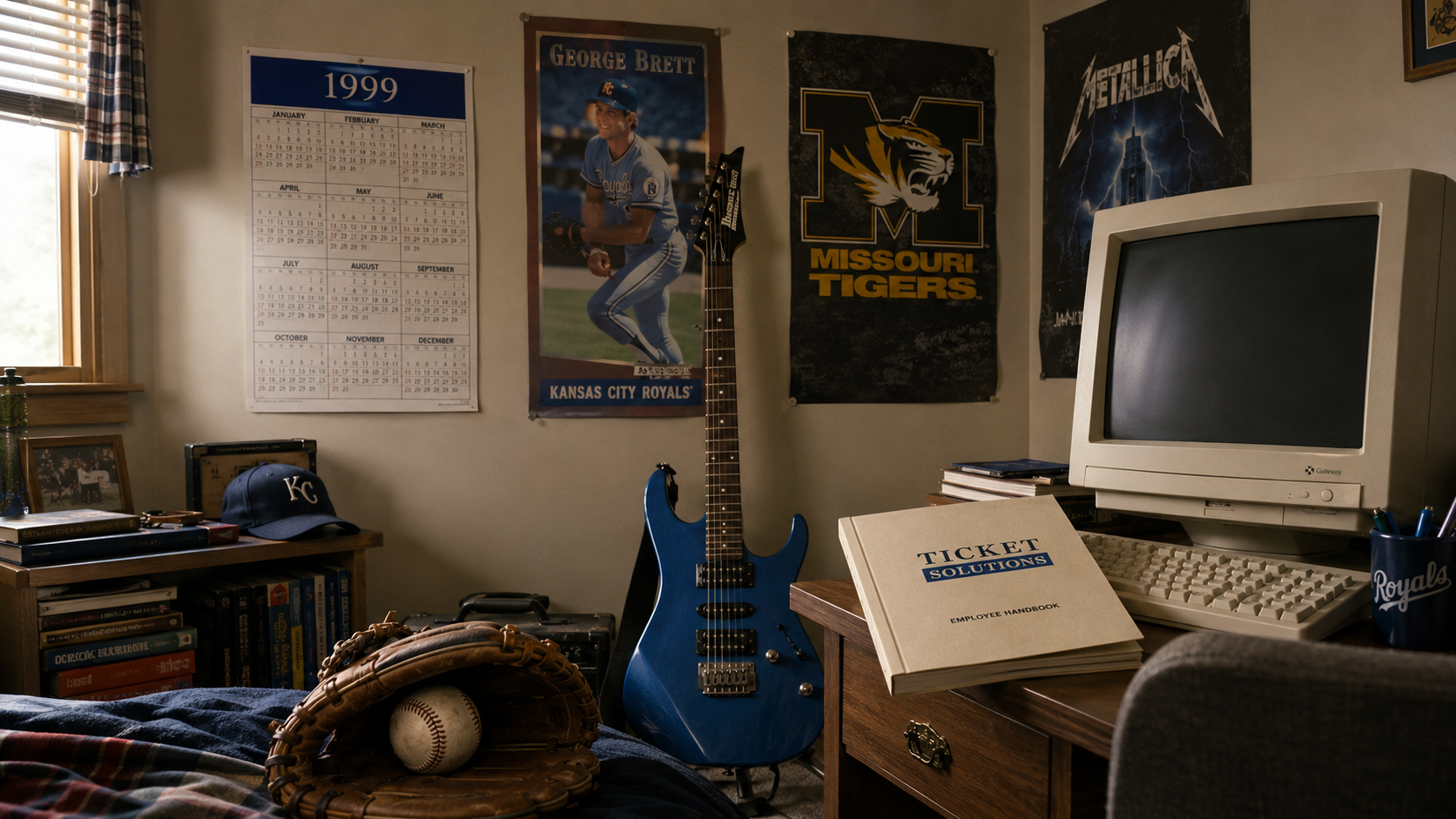
I would go to the University of Missouri, study communications or journalism, and find a life somewhere around writing. There was also a version of the plan where I became a professional baseball player and followed George Brett all the way to Cooperstown. I was a pretty good ballplayer. I was not remotely that good. Childhood plans do not always concern themselves with evidence.

Then, when I was twelve, a kid brought a guitar to summer camp. He played Sweet Child O’ Mine, the girls gathered around, and I decided I would return the next summer with a guitar of my own. That plan did not work either. I found my mom’s old guitar in the basement, took lessons, learned Smoke on the Water and the theme from Spy Hunter, and arrived at camp nowhere near ready to sweep anyone off her feet.

But I kept playing. I formed a hard rock band when I was fourteen. We wrote songs, won a battle of the bands, played a few shows, and recorded a demo tape. Before I turned eighteen, I had been pushed out of the band I started.

Plans change.

After high school, I took college classes in writing, music theory, and movies. Maybe I would become a screenwriter. Then my father died in the spring of 1996. I was eighteen. He was fifty. School stopped feeling important, my grades fell apart, and whatever path I thought I was following disappeared beneath me.

I did not suddenly discover a perfect new plan. I looked for the next thing that still seemed possible.

Computers had been part of my life since I was around ten, but I had never treated them like a career. They were where I tinkered. They were fun. When almost everything else at school was going badly, I took classes in Microsoft Office and Visual Basic and made a couple of B’s with the same effort that had been producing D’s and F’s elsewhere. I remember thinking, I might be onto something here.

Then I met Java.

Object-oriented programming changed the way I saw the world. I could picture software spatially. Data had shape. Systems had relationships. Algorithms stopped feeling like a list of instructions I had to drag myself through and started feeling like structures I could walk around inside. For the first time, something clicked in a way I could not ignore.

That did not make the road easy. During the dot-com boom, companies wanted experience or a diploma and I had neither. I fixed computers under the name Compu-Doc and chased programming, hardware, networking, and even Unix work. Before one interview, I bought Unix for Dummies and read it in the parking lot. The company liked me, but suggested I volunteer to get experience. I had bills to pay, so I declined.

In 1999, I made another plan. I would leave my job, move back to my hometown, buy a house, and complete a three-year Computer Information Systems program. This time I was an A student. I made the Dean’s List nearly every trimester and was on track to graduate Magna Cum Laude. I imagined landing on a Java team at a large engineering company. It felt like the plan had finally settled down.

Two trimesters before graduation, two friends kept trying to recruit me into a small ticket company. I kept saying no. I did not know what a ticket broker was, and it did not look like the future I had pictured. Then the dot-com bubble burst. Graduates who had expected strong development jobs were finding help desk work or nothing at all. I got nervous, called my friends, and asked whether the opportunity was still there.

I walked into the interview and told the owner that hiring me would be one of the best decisions he ever made. I asked for more money than my friends were making and promised I would be worth it. I also told him I could only work thirty hours a week until I finished school.

He hired me.

If my memory is right, I started July 16, 2001. Nearly everyone who knew I was coming was away at a conference. I found a spare computer, built it into something I could use, introduced myself to people, asked what they needed, and started solving a problem.

That part has repeated through most of my career. The title changed. The company changed. The industry changed. The plan changed more times than I can count. Sometimes I stayed too long. Sometimes I bet on people who did not bet on me in the same way. Sometimes loyalty opened a door, and sometimes it kept me standing in a room after I should have left. There were successes, disappointments, promotions, sales, new teams, side businesses, and several moments when I was sure I was finally about to follow the clean path forward.

There was never a clean path.

What I can see now is that the plans were never the most consistent part of the story. The pattern underneath them was.

I build. I solve problems. I walk into unclear situations, find the pieces, and try to make them work together. I did it with computers as a kid, with music as a teenager, with software in the ticket industry, with data and automation across other businesses, and eventually with Transcendent Software, CoffeeBreak, and Open Jibo Cloud.

That does not mean every turn was the right one. Adaptation is not the same as wisdom, and persistence is not always the same as progress. Part of getting older is learning that finding a way forward also means deciding what should not come with you.

Today, I am betting on myself again. The plan is different from the one I had at twelve, eighteen, twenty-three, or even a few years ago. It will probably change again. I hope it does. A plan that never changes is usually a plan that has stopped listening to reality.

The goal is not to find my way back to an old plan. It is to find my way back to the part of me that knew what to do before the titles, expectations, and detours made everything complicated.

Find the problem. Build something useful. Keep going.

Plans change. The work continues.