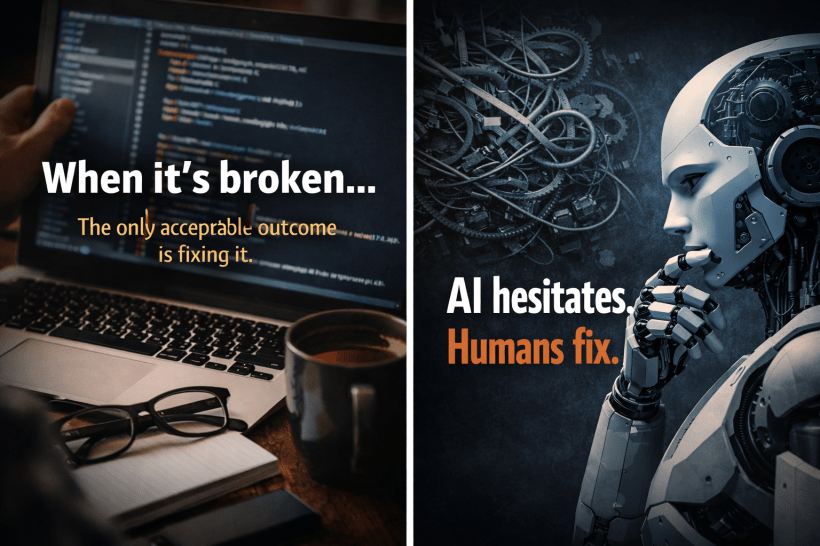

Letting People See the Work Before It’s Finished

There’s a moment in building something where you have to decide who you’re optimizing for.

Early on, it’s just you. Then maybe a small set of ideas, sketches, or prototypes. Eventually, you reach a point where the work is real enough that keeping it completely private starts to hurt more than it helps.

I think I’m at that point now.

The Tension Between Polish and Learning

There’s a strong pull to wait until something feels “done” before letting anyone see it. Polished. Documented. Fully formed.

The problem is that polish often hides the most important feedback.

What I care about right now isn’t applause or adoption. It’s learning. I want to know where people pause, what they misunderstand, and which assumptions don’t survive first contact with reality.

That kind of insight doesn’t come from dashboards or signups. It comes from thoughtful eyes on unfinished work.

Choosing Who Gets to Look

I’m not interested in opening the floodgates yet. Early feedback shapes products, whether you want it to or not, and I’m being intentional about who helps shape this one.

Peers. Builders. People who understand tradeoffs. People who are comfortable saying, “This part feels off,” instead of just asking for features.

That’s who I want looking right now.

Comfortable, Not Rushed

Letting people see something before it’s ready isn’t about being early. It’s about being honest about where the work actually is.

I’m comfortable with people looking. I’m comfortable with it being incomplete. I’m comfortable saying, “This is close, but not finished.”

What I’m not interested in is rushing past that phase just to say it’s launched.

There will be a time to open the door wider. I’m not there yet.

But I’m close enough now that letting people see the shape of it feels like the right next step.

Why I’m Finally Ready to Build This Solution

I’ve had ideas like this before.

Over the years, there have been plenty of moments where a new technology showed up and people rushed to declare that everything was about to change. Sometimes they were right. Sometimes they were early. Sometimes they were just obnoxious and faded out with the fad.

More than once, I chose not to act.

Not because I couldn’t build something, but because it didn’t feel like the right moment. The pieces weren’t there yet. Or the problem was still being solved well enough by humans. Or the solution would have created as many issues as it fixed.

My dad was a video engineer by trade. He was one of, if not the first, people in Kansas City trained to run a slow-motion reel-to-reel machine. His experiences with new and emerging technologies helped shape how I think about when to get involved, and when to sit on the sidelines.

When Chyron video technology began emerging in the 1960s and 1970s, it was used sparingly. My dad wasn’t trained on Chyron yet, but he had an idea. He took a small video camera, mounted it on a tripod, and pointed it at the scoreboard during a baseball game.

Later, he did the same thing for football and other sports.

That simple workaround helped change what viewers came to expect from televised sports. In a nine-inning baseball game, it’s nice to know the inning, the score, and the time at any moment. Today, those elements are permanently embedded on your screen, so normal you don’t even notice them. They’re expected.

My dad saw a technology that wasn’t being used in the best way possible, and he acted at the right moment.

Experience has a way of teaching you when to move. He was right.

It seems like just yesterday

It seems like just yesterday, but I’ve lived through multiple waves of tooling shifts myself. Each one promised to simplify software development. Each one delivered real gains, along with new kinds of friction.

What never really went away was the same underlying problem:
humans doing invisible coordination work between systems that don’t quite understand each other.

We learned to live with it. We staffed around it. We normalized it.

For a long time, that was the right call.

Why This Time Feels Different

What’s changed isn’t just the technology. It’s the combination of things finally lining up, and the growing awareness of the gaps that still need to be filled.

We now have systems that can reason just enough to participate in work, not just execute it. We have workflows that can adapt instead of forcing everything down a single happy path. And we’re finally talking openly about the cost of context switching, glue work, and human babysitting of software.

More importantly, we’ve learned what doesn’t work.

Blind automation doesn’t scale judgment. More tools don’t automatically create clarity. And faster output doesn’t guarantee better outcomes.

Those lessons matter.

Waiting Was Part of the Work

If I’m honest, part of being ready now comes from knowing what I don’t want to build.

I don’t want another system that just moves work faster without understanding it. I don’t want something that replaces human judgment instead of supporting it. And I don’t want to rush something into the world just because the timing feels exciting.

I waited until it felt necessary, not just possible.

Close, But Not Quite There Yet

I’m finally at a point where it feels okay to say that I’m building something. In truth, I have been for months.

I’ll be opening a beta soon. I can’t say exactly when yet. But I’m close enough now that the direction is clear and the product is taking its final shape.

For the first time in a long time, it feels like the right moment to act.

What I’m Paying Attention to as We Head Into the New Year

The stretch between Christmas and the New Year has always been a strange and useful pause.

The calendar hasn’t flipped yet, but the pressure eases just enough to think. Projects slow down. Meetings drop off. You get a little space to reflect without immediately turning that reflection into a plan.

This is usually when I take stock of what’s actually worth paying attention to.

Less Noise, More Signal

There’s no shortage of predictions right now. Every week brings another “AI will change everything” headline, another tool launch, another bold claim about the future of work.

Most of it is noise.

What I’m paying closer attention to is quieter:

  • Where teams are still struggling, even with better tools
  • Where automation helps, but also where it gets in the way
  • How often humans are still doing invisible glue work between systems
  • And which problems keep showing up no matter how advanced the tech gets

Those patterns matter more than any single product announcement.

The Gap That Keeps Showing Up

One thing I keep seeing is a growing gap between capability and clarity.

We have systems that can generate code, route work, summarize decisions, and automate entire workflows. But many teams are still unclear about why certain work exists, who should make which decisions, and when software should act versus pause.

More capability doesn’t automatically lead to better outcomes. In some cases, it just makes existing problems happen faster.

That’s the space I find most interesting right now.

What I’m Intentionally Not Rushing

There’s a strong pull at the start of a new year to rush toward answers.

I’m resisting that.

Some problems benefit from speed. Others benefit from sitting with them a little longer. Understanding how people actually work, where judgment shows up, and where things fall apart, takes time.

I’m okay with that.

Looking Ahead, Quietly

As we move into the new year, I’ll be sharing more of what I’m observing as these ideas take shape. Not polished conclusions, but real thinking in progress.

If you’re curious where that goes next, I’ve started talking out loud in a few places beyond this blog. You’ll find links on the site if you want to follow along.

No pressure. No sign-ups. Just conversation.

Sometimes the most useful thing at the start of a new year is simply paying attention.

The Most Valuable Skill I’ve Seen Engineers Lose, and Why It Matters Now

This time of year has a way of slowing things down.

As winter settles in and we all spend a little more time with family and friends, there’s often a moment when the noise quiets just enough to think. For most people, I’m sure it’s about the magic of the holidays, time with family and friends, or maybe even a warm-weather vacation. For me, my head wanders to my work. Not the next sprint or the next feature, but what actually matters over the long haul.

This year, that reflection keeps coming back to a simple question:

What really makes a great engineer?

After decades in this industry, I’ve seen tools change, paradigms shift, and entire job descriptions come and go. But I’ve also watched one critical skill slowly fade into the background.

And right now, that skill matters more than ever.

It Isn’t Coding Speed or Tool Knowledge

The most valuable skill I’ve seen engineers lose isn’t typing speed, language fluency, or familiarity with the latest framework.

It’s not PR velocity or anything measured by DORA metrics. It’s definitely not who has the deepest front-end framework expertise.

All of those things are valuable. But something else is more important.

It’s the ability to reason through ambiguity.

When I was coming up, we didn’t have the luxury of abstraction layers everywhere. If something didn’t work, you traced it. You reasoned about it. You figured out why.

I’ve mentioned before that I used to test on algorithms in my hiring assessments. They mattered. Not because engineers would be implementing them every day, but because algorithms expose reasoning, tradeoffs, and comfort with uncertainty.

The final part of my assessment was a four-question story titled “One Bad Day.” In it, engineers were faced with real-world problems and incomplete information. There were no right or wrong answers. What mattered was how they handled uncertainty when confronted with it.

Those questions revealed how someone thinks when there isn’t a clear path forward.

As software evolved, we got very good at assembling systems. We got much less comfortable sitting with ambiguity.

Abstraction Is Powerful, But It Has a Cost

Modern tools are incredible. They let us build faster and bigger than ever before. But they also hide complexity, and when complexity is hidden long enough, people forget it exists.

That’s how we end up with engineers who are productive, but uneasy the moment something doesn’t behave as expected. When the happy path breaks, the thinking muscle hasn’t been exercised.

AI accelerates this trend if we’re not careful.

Why This Skill Matters More Now, Not Less

There’s a fear that AI will do the thinking for us.

I believe the opposite.

AI is very good at producing output. It’s much worse at knowing when that output is wrong, incomplete, or misaligned with intent. That gap is where human reasoning becomes invaluable.

The real present in this new era isn’t faster code generation. It’s the opportunity to refocus engineers on judgment, evaluation, and problem framing.

Those are learned skills. They compound over time. And they don’t disappear when tools change.

The Gift That Actually Lasts

As you head into the end of the year, maybe while you’re opening presents or just enjoying a quieter moment, this is the thing worth investing in.

The greatest gift you can give yourself as an engineer isn’t another tool or certification. It’s the willingness to slow down, sit with ambiguity, and reason your way through it.

That skill never goes out of style.

A Peek Under the Hood, How I Think About Building the Next Generation of Dev Tools

When I first got into software, there were no libraries waiting for us. No package managers. No Stack Overflow. No copy-paste from GitHub.

If you wanted to build something, you built it. Top to bottom.

If I needed to talk to another system, I opened a socket. I connected via TCP. I handled the protocol. If something failed, I debugged it at the wire level. Applications were handcrafted end to end, and you were responsible for everything you shipped.

That experience shaped how I think about software to this day.

From Building Software to Assembling Software

As my career progressed and I started hiring engineers, I noticed something changing. We stopped teaching people how software works and started teaching them how to assemble it.

That’s not necessarily bad, but it does change the skill set.

When I built hiring assessments, one of the things I always tested was algorithms. Not because I expected everyone to be writing sorting routines every day, but because algorithms tell you how someone thinks. They reveal reasoning, tradeoffs, and how a person approaches a problem when there isn’t already a solution handed to them.

Over time, that kind of thinking became less emphasized. We got very good at wiring packages together. We got worse at understanding what was actually happening underneath.

That shift matters more than most people realize.

Automation Isn’t New, Context Is

Long before AI entered the conversation, I used to tell teams the same thing over and over. I can automate almost anything, but we need to start with people.

You let humans run the process first. You iron out the edge cases. You understand where things break. Then you automate the boring, repeatable parts and kick the exceptions back to humans.

That model has worked for me for decades.

What’s new now isn’t automation. What’s new is that software can finally understand a little bit of context. Not perfectly, but enough to participate instead of blindly executing instructions.

That distinction is everything.

The Real Cost of Babysitting Software

At one company, I had a peer who was incredibly good at keeping things running. Customers were happy. Issues were handled quickly. From the outside, everything looked fine.

When he eventually left, I dug into the system and realized how much time had been spent babysitting instead of fixing root problems. Not because he didn’t care, but because there simply weren’t enough hours in the day.

The company didn’t push for deeper fixes because the work was getting done. In reality, they were paying a premium for reactive support instead of investing in durable solutions.

That experience stuck with me.

Software that constantly needs human babysitting isn’t efficient. It’s expensive. And worse, it hides the real cost behind “everything is working.”

How My Thinking Has Changed

Today, I care less about features and more about intent.

Where does intent originate?
How is it preserved as work moves through systems?
What happens when that intent becomes unclear?
And when should software act versus pause and ask for help?

These questions matter more to me now than which framework is trending.

Some principles I won’t compromise on anymore:

  • Tools should preserve intent, not just produce output.
  • Automation without context just accelerates the wrong outcomes.
  • Humans are not a failure mode, they are part of the design.
  • Software should adapt to people, not force people to adapt to it.

Why This Is Finally Possible

For most of my career, software was deterministic because it had to be. That made context preservation incredibly hard.

Now we have systems that can reason, summarize, adapt, and operate with uncertainty. We can design workflows that branch. That pause. That escalate. That involve humans when confidence drops.

This doesn’t replace judgment. It finally gives judgment a place to live inside the system.

A Quiet Tease

I’m working on something that reflects all of this.

It’s shaped by decades of building software the hard way, watching teams struggle with invisible friction, and seeing how often people end up doing work that tools should have handled better.

I’m not ready to talk about it publicly yet.

But if modern dev tools feel powerful and exhausting at the same time, we’re probably thinking about the same problem.

More soon.

What Yoda taught me about being a mentor

Like I mentioned in my blog post, What I’ve Learned from Mr. Miyagi, the elderly, wise, green alien creature from the Star Wars saga, Yoda, was another model for how I learned to be a great mentor. I didn’t know it at the time, but while I watched The Empire Strikes Back when I was a young boy, I was learning many life skills while I dreamed of being Luke Skywalker flying an X-Wing, commanding the force, taking on the bad guys, and learning to overcome the dark side, and in particular, Darth Vader.

Yoda was introduced into the story when Luke Skywalker crash lands into Dagobah, a swampy forest planet. After a moment trying to gather his surroundings, Yoda arrives in scene as a quirky, curious, alien creature who speaks in broken english, but still shows some sarcastic and quippy wisdom when he speaks. For instance, when Yoda asks Luke why he is there, after some banter, Luke states, “I’m looking for a great warrior.” Yoda immediately in his broken english language states, “Great warrior? War’s not make one great.”

You can watch the entire dialog above, but the truth of the introduction is that Luke is overconfident, and almost cocky. He has many thoughts about how everything works, how he is supposed to become a Jedi Knight, how his destiny is supposed to pan out, and in reality, he has much growing up to do. Luke is like many of us when we start out on our career paths. We have a small education and maybe some bits and pieces of real world experience, but in practice, we don’t have much experience at all.

Many of us, when seeking mentorship, are ready to receive it. Luke, on the other hand, was not. He argues with Yoda and Obi Wan Kenobi’s force ghost about whether he is ready to be a Jedi Knight or not. Eventually, they all agree he will finish what he starts and become the Jedi Knight he is meant to become. This submission of will is important, because being a good mentee is about submitting to the process, knowing that in the future you’ll be able to expand your wings and fly on your own.

Yoda trained Luke on calming his mind and approaching challenges in a clear frame of mind and to stay focused. He also taught Luke small concepts and allowed him to build upon them later, even though he didn’t know why he was doing them in the first place. This idea of foundational building was something I explored with how Mr. Miyagi trained Daniel in The Karate Kid. This was the same with Yoda. He started by having Luke move small objects with the force. Later in the training scenes, he had Luke try and move his X-Wing from the swamp as it began to sink. He utters some of his best lines during this scene, “No. Try not. Do or do not, there is no try.” or Luke saying, “I don’t believe it,” when Yoda uses the force to move his X-Wing from the swamp and Yoda replies, “That is why you fail.”

I use these same techniques when I mentor. I often only give out bite size pieces of information which are enough to get the job at hand completed. This allows my mentees to become masters of that technique faster, and later one we can connect the dots. Keeping things simple is a core value of mine. Not only is it the best way to keep things progressing, but there are many times I learn new techniques as well. As I have explored in many of my previous posts, including Teach a Man To Fish, I point out that the best leaders and mentors surround themselves with smart people, and allow them permission to fail. Everyone gets an opportunity for growth this way.

In conclusion, Yoda and many other wise sages in many movies taught me much about how I mentor today. Lessons such as keeping things simple, staying focused and submitting to the process are all key to growth. We will explore this more in the future, but for now, venture out and try these things out for your teams.  May the force be with you.

What I’ve Learned From Mr. Miyagi

Like many kids who grew up in the 1980’s, I learned a lot about life from two wise sages. First, was Yoda, the green, grumpy, 900 year old Jedi master, who trained Luke Skywalker to reach his potential and overcome against all odds to destroy the dark side forever (Well, at least until Episode VII came out in 2015, because the dark side somehow came back again). I often quote Yoda to my wife’s dismay with, “No. Try not. Do or do not. There is no try.”

We’ll tackle Yoda in a future post, but in the interest of staying more grounded in reality, I’d like to focus on my second choice, and that is Mr. Kesuke Miyagi or Mr. Nariyoshi Miyagi, as he went by both names in the movie series. For the purposes of how I knew him, Daniel Laruso, his student in most of the movies, called him Mr. Miyagi, so that is how I knew him as well.

Mr. Miyagi was a fictional character, but the things he did and said in the three Karate Kid movies (I know there was a fourth one much later and then a remake after Pat Morita died featuring Jackie Chan as the Karate mentor) were very much things that shaped who I am and how I live my own life, even today. I constantly find myself quoting Mr. Miyagi as well. “Walk on the road? Walk right side safe. Walk left side safe. Walk middle, sooner or later get squished just like grape.”

Mr. Miyagi seemed to always have a solution, but I think it was just a confidence in his response, even if he didn’t know how the outcome might play out. In the first movie, there was a scene on the beach where some racist drunk guys didn’t want to move from their spot so Mr. Miyagi and Daniel could leave. They had taken up shop on Mr. Miyagi’s truck and had placed several empty beer bottles there. Mr. Miyagi asks them to remove the bottles so they can leave and they refuse. He then proceeds to Karate chop the beer bottles in half, and the guys remove them and scurry off. Daniel asks Mr. Miyagi how he did that, and he simply replies, “I don’t know. First time.” You can watch below, skip ahead to about 2:36 for the scene.

This scene is perfect Mr. Miyagi with a little humor and humility, simplicity and yet in complete control. This is a theme with Mr. Miyagi throughout the entire series. Another scene that demonstrates this is when he takes Daniel to the Cobra Kai dojo to talk to the bully kids and their sensei in hopes that they might leave Daniel alone. When Mr. Miyagi realizes this won’t happen he volunteers Daniel to fight in the All Valley Karate Tournament in return for no more bullying. The sensei agrees. After leaving Daniel is furious that he has to fight, and Mr. Miyagi says something to the effect of, “I just saved you two months beatings!”

Mr. Miyagi taught Daniel lessons using cryptic methods, but it all came back to simplicity. I’m sure nearly everyone knows “Wax on. Wax off.” or “Sand the floor.” or “Paint the fence.” or “Side to side”. These being his way of instructing Daniel in the basics of self defense. He also had him do manual labor to build strength and endurance.

Mr. Miyagi understood how to live a rewarding life, even though you knew throughout the films that he struggled with this himself. He was an immigrant and veteran of World War II. He lost his wife and unborn child during the time he was away at war and never really let go of this, and while they never stated it directly in the movie, they definitely implied he probably battled some sort of alcohol abuse grieving these losses. He at least commemorates the anniversary each year by dressing up in his military uniform and by getting hammered to the point he passes out. Daniel finds him during an anniversary and sees a side of his friend and mentor to show he is just a man with flaws who is doing the best he can.

In the second movie, we discover that Mr. Miyagi also had a relationship before he left Okinawa. He and his best friend were going to fight to the death over a woman, and Mr. Miyagi knew he couldn’t kill his friend, so he gave up his love and left the island. When he returns he finds that he still loves her and she never married and never stopped loving him either. Of course, as these things go, he leaves to go back home at the end, but he and his friend patch up their relationship before he leaves, and all is well (I guess?).

Mr. Miyagi, while a man with flaws, also shows great wisdom in the entirety of the series (even the fourth film I suppose). He says statements of simplicity and devises simple challenges to get his points across and be the best mentor and friend to Daniel he can be. As a leader, there is much to be learned from Mr. Miyagi’s approach to leadership. Keeping things simple is often the best way to empower those you lead to take ownership themselves and become the best they can be while you nudge them in the right direction from time to time.

One Play at a Time

Today brings sad news that former NFL head coach, Marty Schottenheimer, is suffering from early onset Alzheimer’s Disease. There are plenty of news sources reporting that he has been suffering from this terrible disease now for about five years.

Legendary NFL Coach Marty Schottenheimer Selling Carolina Mansion ...

As a Kansas Citian who is still in his 30’s (barely), my formative years were spent watching Marty lead the Kansas City Chiefs using awe inspiring quotes about getting the gleam, igniting the rocket ship, or taking it one play at a time. His voice was familiar to me, as every time I turned on the radio or television, I couldn’t escape his voice saying, “Nothing stops a Trane”, as the spokesperson of Trane HVAC systems. His voice was so familiar he seemed like someone I knew, like a long lost uncle.

Marty was an iconic figure in my mind and to me was the epitome of a head coach. He was known for Martyball, with his run dominated offense and outstanding defenses. He even got a polka song written for him! He led talented and not so talented teams to really good records. He only had two losing seasons in his career, his final one in Kansas City in 1998, where the promising season derailed and finished at 7-9 and his second season in San Diego in 2003, where they went 4-12, but followed that record in 2004 with a 12-4 record and first place finish in the AFC West.

Schottenheimer smitten with Thomas from the start - News - The ...

With all of his success, he still kept things very simple. He was very focused on the task at hand and didn’t get caught up in looking backwards or forwards. This is something I try and do in my career and life. In any situation, you only have control over your next action. You can’t hit the undo button and get another shot at what you already did and you can’t skip forward and change the future.

Marty Schottenheimer's congratulatory message for Andy Reid | The ...

This is the lesson that I learned by watching Marty Schottenheimer coach the Kansas City Chiefs in the 90’s. His teams were so good at moving onto the next play and not dwelling on the past. I can recall countless times I watched defensive stands, last second field goals, blocked kicks or kick returns for a win. If you think of all of the times you have failed before, you’ll never be prepared to succeed when called upon. This is what Marty represents to me. He now has an incredible fight ahead of him as he undergoes experimental treatments and continuing loss of his faculties as this disease progresses. Knowing Marty from being the fanatic observer I was, I know he will continue to live his life one day at a time and appreciate every moment, because that is all he can do.

Go get ’em coach!

Build Your Team With Character First

So much can be said about character. To me, it is the number one thing I look for in another person in any walk of life, not just professionally. Character is our moral fiber. It is what makes us who we are and it provides us what we need when we are at our whit’s end.

Mark Twain said, “It is curious that physical courage should be so common in the world and moral courage so rare.” I don’t know if it is so rare or it is just not advertised. Doing the right thing, being paitent and kind, being strong when the chips are on the line, these are things that just aren’t talked about. They are exactly the types of things I look for in those around me.

I am a huge football fan. My team I root for is the Kansas City Chiefs. In 1998, after a very good run in 1997 and a 13-3 regular season record and a disappointing loss to the division rival Denver Broncos in the divisional round of the playoffs, Marty Schottenheimer was going all-in to try and win a Super Bowl. He brought in several players of questionable character, but with above average talent. This move backfired and Marty experienced his first and only losing season in his coaching career, going 7-9. Marty went against his moral fiber and brought in players purely on talent. He never did this again in his other coaching stops. He only had one other losing season.

In my own career, I have spent much of the interview process talking with the candidate. I’ve been known to take a candidate to Starbucks and buy them a coffee and just try and get to know them. During nice weather, I might take them on a walk through the trails by our offices if their shoes are up for it. This approach tells me more about the person and I also get a feel for their qualifications. I can always coach them up or teach the person a skill, but I can’t teach them to be a person I trust with the operation and execution of my future and the futures of those I work with.

In short, when looking to who to surround yourself with, look to character before talent and you’ll do much better in the long run. I’ve mentioned George Washington as one historical person I’ve looked up to as a leader. He was quoted as saying, “It is better to be alone than in bad company.” There is so much truth in this short statement.

Teach A Man To Fish

Everyone has heard the expression, “Give a man a fish and you feed him for a day; teach a man to fish and you feed him for a lifetime,” or some variation of this. In fact, it’s been quoted, paraphrased, blogged, memed and parodied so many times, it hardly seems blog post worthy anymore. The phrase itself is a fairly novel concept. The real reward in life is learning to be self sufficient and to not be dependent on others. This is truly where happiness comes from. A new penny loses it’s shine eventually and is just a penny, but if you know how to make that one penny into many pennies, the reward is so much greater. Blah, blah, blah, etcetera, etcetera, etcetera. We all know this, right?

When I got started in IT leadership, I was so obsessed with making sure things were handled to my standard that I hoarded much of the work. I would tell myself that I was protecting my employees from having to deal with such things, but in actuality I was hindering their development. There was the occasional employee I felt so comfortable with that I would hand one particular project to them and let them own it, but for the most part I felt like I had to have my hands on everything that was going on. I felt if I didn’t do this, we would fail. I felt such ownership over every piece of software, hardware, process, or procedure that I couldn’t let it go.

I can still remember having several conversations with my boss about delegation. We talked on the subject often, and I understood that it was something I needed to get better at, but I sure didn’t know how. How do you own something, and be responsible for it’s success and yet let other people do it? This concept was hard to grasp. It was hard to grasp for him too, but we both vowed to get better at it.

washington-meeting-his-generals-war-is-hell-store

I remember seeing a program about George Washington once, and on the program they talked about his leadership style. George would gather those whose opinions he valued, hear them out and make a call. I visualize them in a circle around some old 1700’s wood table made from a tree trunk, standing of course, in full dress for the period. I picture them with their wigs and hats. George would address the group with the issue, and then he would back off and let them all talk about it. He would observe and in the end I picture him clearing his throat to a silence of the crowd and just telling them how it is. George took the opinions and ideas and formulated his own idea and then that is what happened. That is my image of a good leader. The thing was, George had those around him that he trusted to provide value. How did he get to that point? Sure you could say it was because he served in the trenches with them. You could say it was because George always had the absolute best around him at all times. The truth probably is that George did his best to teach them all to fish. He made them better, so in the end he was better at his job.

fish

To come full circle, I think we can learn something from George Washington. For us to be the absolute best version of ourselves, it is our responsibility to teach everyone around us to fish. In business, now, I think I do a much better job of this. I give everyone who works for me the permission to fail. In fact, I encourage it. I want them to try to solve problems on their own. I tell them that my door is always open to talk through what they are working on, but in the end, they are the ones working on it. I will not do it for them, even at the expense of the project or a deadline. In my early days, I had no problem sitting down at my employee’s workstation and running through the solution to whatever problem they were working on and not thinking twice about it. Each time I did this, I was setting them back days, weeks, or months in their development and maturation as a technology professional. To be the best leader I can be, it is up to me to make those around me the absolute best they can be. If I do this, in the end, we will all reap the rewards of learning to fish.